
- What is a Heat Exchanger?
- How Heat Exchangers Work
- Different Types of Heat Exchangers
- Understanding Shell and Tube Heat Exchangers
- Understanding Plate and Frame Heat Exchangers
- What are Finned Tube Heat Exchangers?
- How Heat Exchangers work in Boilers
- Choosing the Right Heat Exchanger for Your Application
- Common Applications of Heat Exchangers
What is a Heat Exchanger?
A heat exchanger is a device designed to transfer heat between two or more fluids without mixing them. This transfer of heat can occur between liquids, gases or a combination of both.
The main job of a heat exchanger is to efficiently manage temperature changes without the fluids mixing.
Explore our range of efficient heat exchangers
How Heat Exchangers Work
Heat exchangers operate on the principle of heat transfer, where heat from a hot fluid is transferred to a cooler fluid through a solid barrier. This process can occur in several configurations, including parallel flow, counterflow and crossflow, depending on the specific design and application of the heat exchanger.
In a simple heat exchanger, the hot fluid flows on one side of the heat exchanger, while the cold fluid flows on the other side. The heat from the hot fluid is transferred to the cold fluid through the heat exchanger’s walls, resulting in the heating or cooling of the fluids. This efficient heat transfer is crucial for maintaining the desired temperature in various systems, from industrial processes to HVAC systems in buildings.
Different Types of Heat Exchangers
The main types of heat exchangers include:
- Shell and Tube Heat Exchangers: Consist of a series of tubes, with one set of fluids flowing through the tubes and another set flowing outside the tubes but inside a shell. They are known for their robust design and efficiency in handling high pressures and temperatures.
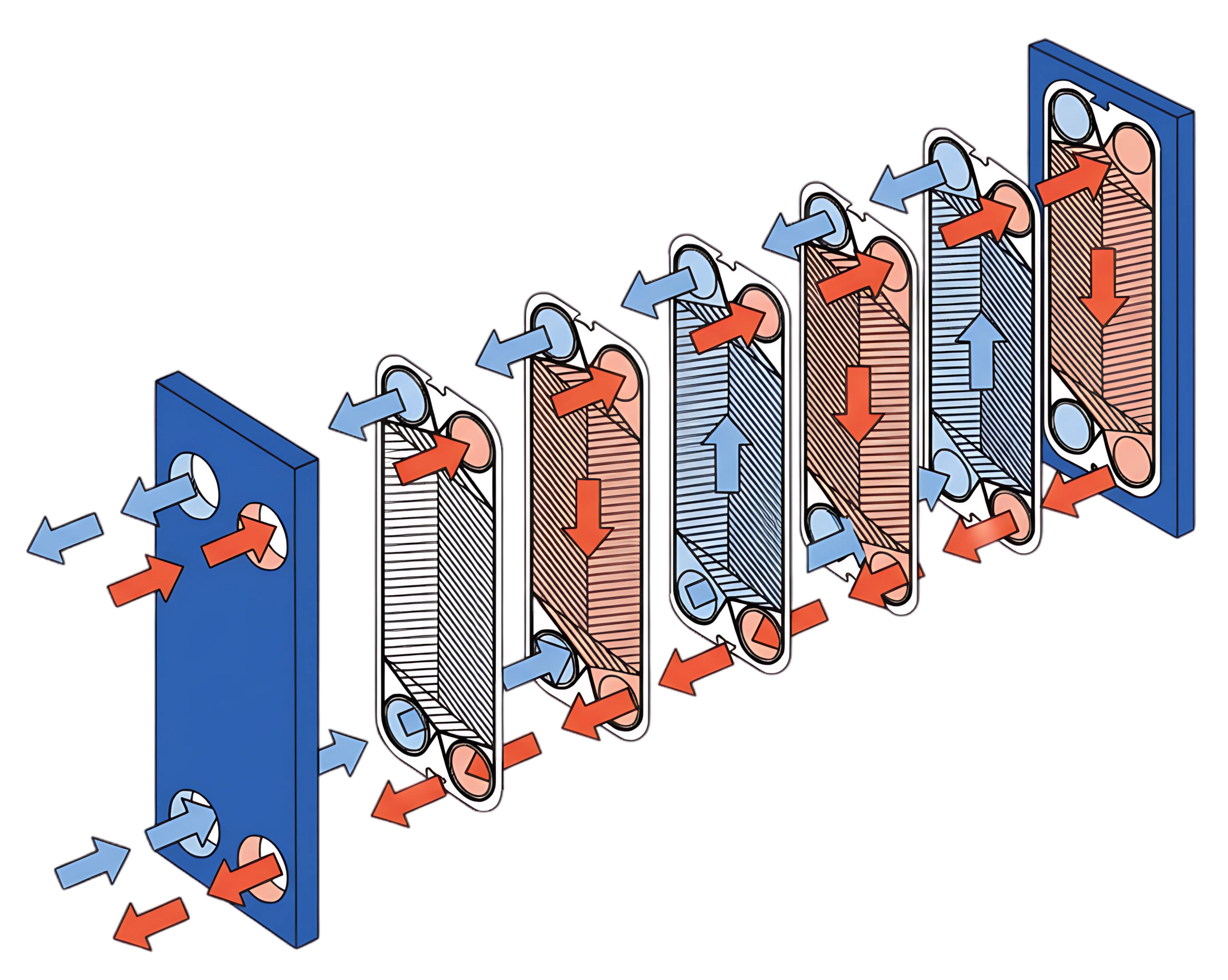
- Plate and Frame Heat Exchangers: Made up of a series of thin, corrugated plates that allow fluids to flow between them. These heat exchangers are compact and offer high heat transfer efficiency.
- Finned Tube Heat Exchangers: Utilise fins to increase the surface area for heat transfer, making them ideal for applications requiring high efficiency in a compact space.
Each type of heat exchanger has unique benefits, making them more suited to specific applications. It’s crucial to understand the differences before selecting one.
Browse our range of heat exchangers
Understanding Shell and Tube Heat Exchangers
Shell and tube heat exchangers are one of the most common types of heat exchangers used in industrial applications. They consist of a series of tubes, with one set of fluids flowing through the tubes and another set flowing around the tubes within a cylindrical shell. This design allows for efficient heat transfer between the fluids.
The shell and tube heat exchanger’s design is highly versatile, making it suitable for a wide range of applications, from power plants to chemical processing. The ability to handle high pressures and temperatures makes these heat exchangers ideal for demanding environments where robust performance is essential.
Understanding Plate and Frame Heat Exchangers
Plate and frame heat exchangers consist of a series of thin, corrugated plates that create channels for fluid flow. The fluids flow alternately between the plates, allowing for efficient heat transfer through the large surface area provided by the plates. This design makes plate and frame heat exchangers highly efficient and compact.
These heat exchangers are commonly used in applications where space is limited, and high heat transfer efficiency is required. They are also easy to maintain and clean, making them a popular choice in industries such as food processing, pharmaceuticals and HVAC systems.
What are Finned Tube Heat Exchangers?
Finned tube heat exchangers use fins to increase the surface area available for heat transfer, enhancing their efficiency. The fins are attached to the tubes, allowing more heat to be transferred between the fluids flowing through and around the tubes. This design makes finned tube heat exchangers ideal for applications where high heat transfer rates are needed in a compact space.
These heat exchangers are commonly used in applications such as air conditioning, refrigeration and industrial process cooling. The increased surface area provided by the fins allows for efficient heat transfer even in systems with limited space.
How Heat Exchangers work in Boilers
Heat exchangers play a crucial role in boilers by transferring heat from the combustion gases to the water or steam within the boiler. This process ensures efficient heating and reduces energy consumption. The boiler heat exchanger is designed to maximise heat transfer while minimising heat loss, ensuring optimal performance.
In a boiler system, the primary heat exchanger transfers heat from the combustion gases to the water, while the secondary heat exchanger may be used to preheat the incoming water, further enhancing efficiency. This efficient use of heat exchangers in boilers helps in reducing fuel consumption and emissions, making them an essential component in modern heating systems.
Explore our range of boilers featuring stainless steel heat exchangers
Choosing the Right Heat Exchanger for Your Application
Choosing the right heat exchanger involves considering various factors such as the type of heat exchanger, fluids involved, temperature and pressure requirements and space available. Understanding the specific needs of your application is crucial for selecting the appropriate heat exchanger.
For instance, if space is limited and high efficiency is required, a plate and frame heat exchanger may be the best choice. On the other hand, if the application involves high pressures and temperatures, a shell and tube heat exchanger might be more suitable. It’s also important to consider the maintenance and cleaning requirements, as some heat exchangers are easier to maintain than others.
Contact us for expert advice on selecting the right heat exchanger
Common Applications of Heat Exchangers
Heat exchangers are used in a wide range of applications, including:
- HVAC Systems: Heat exchangers are used to transfer heat between the indoor air and the outside environment, providing efficient heating and cooling.
- Power Plants: Heat exchangers are used to transfer heat from the combustion gases to the steam used to drive turbines, generating electricity.
- Chemical Processing: Heat exchangers are used to control the temperature of chemical reactions, ensuring optimal conditions for production.
- Food Processing: Heat exchangers are used to pasteurize and sterilize food products, ensuring safety and quality.
Want to learn more? Check out our latest guide on plate heat exchangers, where we discuss packaged, gasketed and brazed designs.
Read our ultimate plate heat exchanger guide
Summary
- Heat exchangers are essential devices that transfer heat between fluids without mixing them.
- They operate on the principle of heat transfer, using various configurations such as parallel flow, counterflow and crossflow.
- The main types of heat exchangers include shell and tube, plate and frame and finned tube heat exchangers.
- Shell and tube heat exchangers are versatile and suitable for high-pressure and high-temperature applications.
- Plate and frame heat exchangers are compact and highly efficient, making them ideal for space-constrained applications.
- Finned tube heat exchangers use fins to increase surface area and enhance heat transfer efficiency.
- Choosing the right heat exchanger involves considering the specific needs of the application, such as temperature, pressure, and space requirements.
- Common applications of heat exchangers include HVAC systems, power plants, chemical processing, and food processing.