Choosing between a Brazed vs Gasketed Plate Heat Exchanger isn’t just about heat transfer, it’s about balancing plant room footprint, maintenance budgets and long-term system scalability.
Several key factors determine the best fit for each project, this guide will help you choose the right plate heat exchanger for your specific application.
What’s the Difference Between a Brazed vs Gasketed Plate Heat Exchanger?
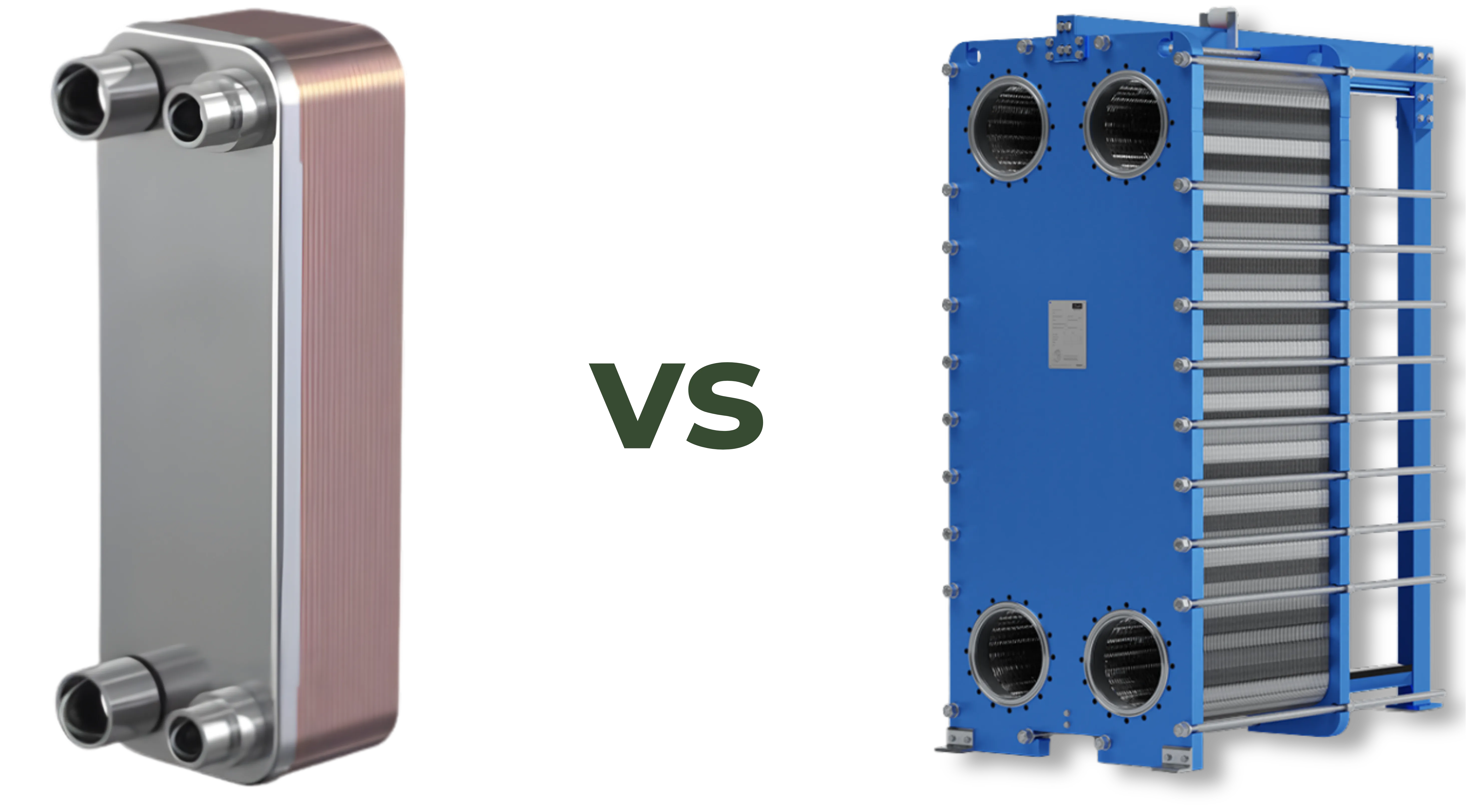
What is a Brazed Plate Heat Exchanger?
A Brazed Plate Heat Exchanger (PHE) eliminates the need for traditional gaskets and bulky frames. Instead, stainless steel plates are permanently fused using a brazing process (typically with copper or nickel).
- The Result: A fully sealed, high-integrity unit that is significantly smaller and lighter than a gasketed PHE.
- Best For: Demanding applications with high operating pressures, extreme temperatures or a space restricted plant room.
- The Trade-off: These are “sealed-for-life” units. They cannot be opened for manual cleaning or expanded if the building’s load increases.
Browse Our Brazed Plate Heat Exchangers
What is a Gasketed Plate Heat Exchanger?
Gasketed units use elastomeric gaskets between each plate to seal the flow channels and guide fluid movement. The entire plate pack is compressed between heavy-duty steel frames using tightening bolts.
- The Result: A robust, serviceable and modular system.
- Best For: Systems prone to fouling (where manual cleaning is required), Domestic Hot Water (DHW) where plate inspection is critical and projects where future expansion is likely.
- The Trade-off: They require a larger footprint and periodic gasket replacement to prevent leaks.
View Our Gasketed Plate Heat Exchangers
Which Plate Heat Exchanger Technology Fits Your Project?
Specifying the correct heat transfer technology is critical for system efficiency and ease of maintenance. Compare the core capabilities of each unit below to find the optimal fit for your application.
| Brazed PHE | Gasketed PHE | |
| Construction | Plates permanently brazed together (no gaskets or frame) | Bolted frame with gaskets between plates |
| Maintenance | Not serviceable internally, typically replaced as a whole unit | Can be disassembled for cleaning, inspection and repair |
| Sealing | Metal brazing provides a permanent, leak-tight seal | Elastomer gaskets provide sealing (may degrade over time) |
| Size & Weight | Very compact and lightweight | Larger and heavier due to frame and bolting system |
| Flexibility | Fixed capacity, cannot be expanded | Highly flexible, plates can be added or removed to adjust capacity |
| Thermal Efficiency | High efficiency due to turbulent flow and thin plates | High efficiency and can be optimised by plate configuration |
| Cost | Lower initial cost but higher replacement cost over time | Higher upfront cost but lower lifecycle cost due to serviceability |
| Application | HVAC, refrigeration, domestic hot water, small industrial systems | Industrial processes, food & beverage, chemical, and applications requiring frequent cleaning or capacity changes |
Still need support identifying the best PHE for your application?
Get free system selection support
Key Selection Criteria for Bare Plate Heat Exchangers
When selecting between brazed and gasketed plate heat exchangers, consider:
- Fluid Quality
Dirty or fouling fluids → Gasketed
Clean, closed-loop systems → Braze - Maintenance Strategy
Planned maintenance access available → Gasketed
Minimal maintenance / replace-on-failure → Brazed - Space Constraints
Tight plant rooms → Brazed
Space available → Gasketed - Future Capacity Changes
Likely → Gasketed
Fixed load → Brazed - Operating Conditions
Very high pressures/temperatures → Brazed
Still Unsure Which Heat Exchanger Suits Your Project?
Choosing between a brazed or gasketed plate heat exchanger comes down to operating pressures, thermal loads, maintenance access, and long-term operating costs. Making the right specification early prevents costly plant room retrofits down the line.
At Virdis Energy, our technical specialists evaluate your exact flow rates, fluid characteristics, and maintenance requirements to recommend the most reliable, cost-effective heat exchanger solution.
Contact our technical team for expert selection advice, sizing support, or genuine spare parts.
Buy heat exchanger parts online